
The other day I went for a walk with friends through some beautiful countryside. It was a warm and sunny day, lovely walking weather. At one point the path took us quite steeply down a tiny little valley – just a dip in the landscape really, with a little brook running through the bottom and trees all around. Suddenly the temperature cooled as we dropped down to the water. It was so refreshing!
I have been reading through this big tome bit by bit in my times of contemplation. Currently, it has got me praying for the trees…

Today I am shocked to find that the wonderful forests of British Columbia, which I feel more connected to because of a friend who lives near to them, turned from being a significant carbon sink (good) to being a source of carbon (baaaad) in 2002, due to increased temperatures, which enabled mountain pine beetles to proliferate (fewer of them dying over winter as the winter temperatures have been warmer and there’s been less snowpack). The beetles bore through the bark of trees to lay their eggs, which kill the trees by consuming and blocking the flow of nutrients to the trees. The deadwood caused by this has made the forests more susceptible to wildfires, which emit a LOT of carbon into the atmosphere.
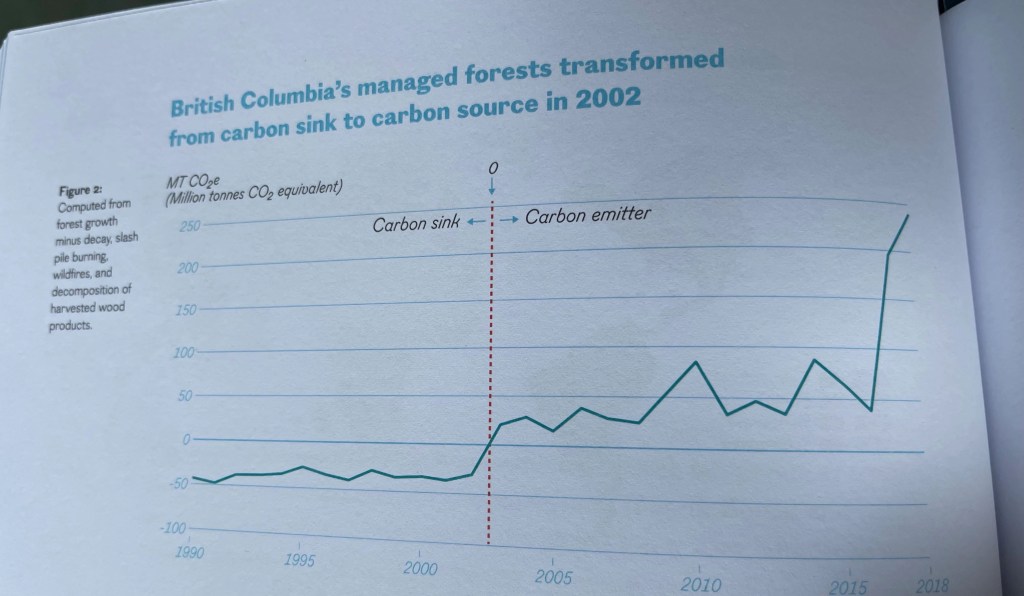
Now the forests in BC are a larger source of carbon than reported emissions from the energy sector in the region, according to a provisional 2021 report.
However, as with all the short articles in this book there is hope…
The hope lies in reducing the frequency of logging (cutting down trees for wood). This has the potential to enable the forest to become a carbon sink again, storing lots of carbon in the ground instead of releasing it into the atmosphere and causing more global warming. Also this means more mature trees for people animals and plants to enjoy for longer. The positive impact of doing this would be the single biggest thing that could be done in this type of region by the look of it. (Harvest reduction means reducing the logging frequency on this chart. Much quicker/more effective than planting new trees.)

For this to work, all of us, and especially those of us in richer countries, need to stop consuming wood. In any which way. To stop buying things made of wood, or living in such a way that we effectively are demanding the current level of wood harvesting, which is driving these companies to harvest wood on this ridiculous scale.
In New Zealand some years ago I remember seeing a lot of lorries transporting long logs (really I saw more of those than any other type of traffic in the more remote areas). And a lot of forest plantations where trees are grown only in order to be chopped down before they are fully mature to be used for wood. These half logged “managed” forests looked like ugly wounds on an otherwise jaw droppingly beautiful landscape. The same thing happens in the UK and all over the world.
So today I am praying for the trees. And wondering how I can consume less, intentionally. I want to be part of the solution not the problem…🙏🌳💕🌲
 la perle
I’d like to suggest a short term but large *increase* in the amount of logging. Beetle-bored timber probably isn’t as desirable as its planters budgeted for, so they’ll likely go bust and leave the forest without stewardship. I imagine that such timber could be pulped for paper and, here’s an idea, burned in wood-fired power stations. If it’s going to burn anyway, presently in uncontrolled and dangerous conflagrations, better that it burns such that we leave coal and oil in the ground. That will require that it’s cheaper than the alternative, which has the likely consequence that there will be profiteering, by organizations that you might find unsavory, from government subsidy. That might be preferable to spending the money ineffectually trying to extinguish the fires.
The managed forests wouldn’t be much good for animals or people, even if you let them mature. They’re monocultures, planted in a regimented way, so they can be harvested with maximum economy.
LikeLike
Yes I think the beetle boring is happening in the natural forests probably more than the plantations? Totally agree the plantations are not helpful either.
LikeLike
Hi Ali x
Re “all of us, and especially those of us in richer countries, need to stop consuming wood… To stop buying things made of wood, or living in such a way that we effectively are demanding the current level of wood harvesting, *which is driving these companies to harvest wood on this ridiculous scale*” (my emphasis).
I think this is the wrong way round. Capital’s imperative is to maximise economic growth (aka produce the highest possible returns on capital) and it’s this which has been driving exponentially increasing rates of resource extraction for most of the 20th and 21st centuries. For sure as individuals we’re sucked into consuming more and more e.g. by advertising, production of products which don’t last (*best* new build life expectancy in UK is 40 years) etc etc.
By all means pray for the trees, but if poss also for the end of capitalism and all its works…
LikeLiked by 1 person
Yes absolutely agree with this. The motor that is driving all the over consumption is capitalism. And that is pretty much a constant prayer of mine for it to somehow be stopped it its tracks. I’m not sure whether it’s selfishness and greed that drives capitalism or whether capitalism drives/plays on our selfishness and greed. Whichever way round it is, I long for us to somehow stop the cycle of doom and for our energy and resources to coalesce in a more positive direction. I am also really a contributing part of this system though as well. Wondering how I can extract myself /find better ways of being/ become part of the solution…
LikeLike
Much of the legal infrastructure of “rich” countries in the Global North was established to facilitate capital. This goes all the way back to “the enclosures”, the legalised theft of common land to enable its exploitation (and the exploitation of the labour of the now landless working class) by capital (forgive me if you know all this already). It’s that enabling of capital which needs to change, not human nature (greed / selfishness) – which I suspect we can’t do too much about anyway. E.g. we could make laws which privilege co-operative enterprises. We could decide that there are some areas of activity which we should just not be doing at all in the midst of a climate crisis.
As to how this can be brought about, that’s the hard bit! But I believe it will need grassroots bottom-up activism and campaigning in particular by young people, and this can be the positive bit – because there is so much else apart from climate change benefits that would be improved about a world organised differently. Also it’s clear that placing significant reliance on our current political processes to solve this would simply be the triumph of hope over experience.
LikeLiked by 1 person