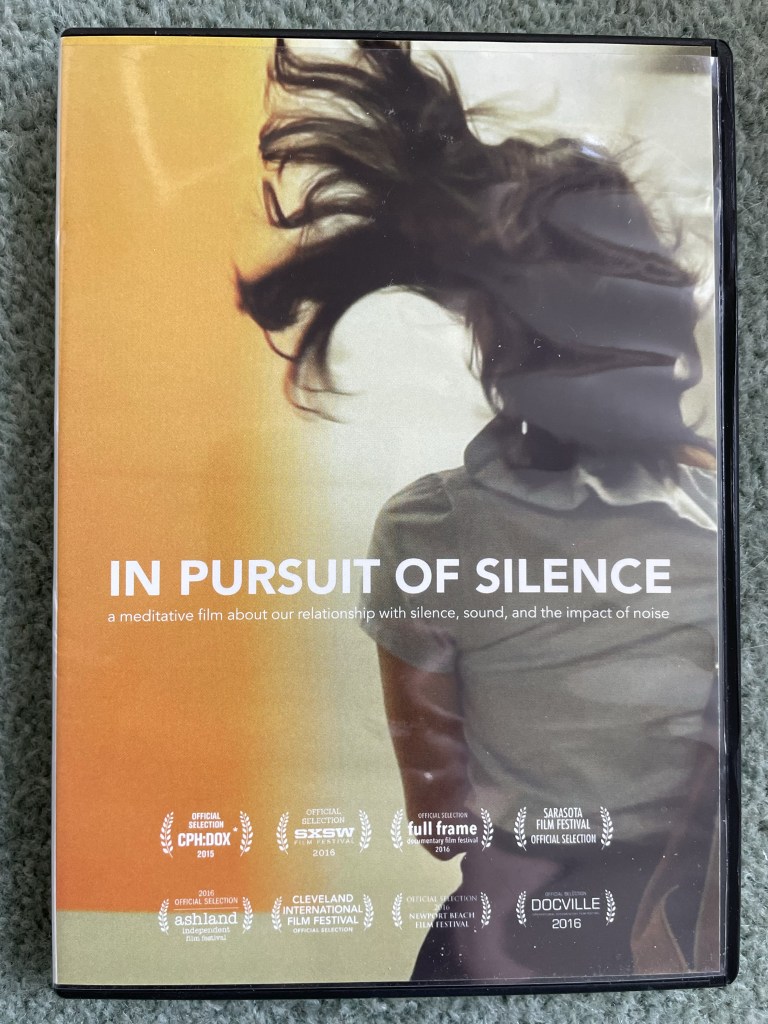
This is the title of my all time favourite documentary film, which I saw the first time it screened in the UK in 2016 in between my daily radiotherapy appointments for cancer treatment. The film blew my mind. And resonated in such a gentle, inspiring and positive way. It drew my attention with its beauty (it is wonderfully shot), and the quiet joy of its soundtrack. It is an exercise in contemplation just watching it. An act of rebellion against the drivenness and thoughtless, damaging noise of our time.
I watched it at the Sheffield Doc Fest, the international film festival for documentary makers, and the q&a following with Patrick Shen the film maker was also an inspiration. I knew about Sheffield Doc Fest but had rarely managed to prioritise going to see many films. Watching this during my cancer journey helped me to begin to re-evaluate a lot of things.
For one thing, if a film could inspire me and resonate with me so much that it held the potential to alter my way of being, I resolved never to let work or life stop me from drinking in the films that arrive each year in the very city I live in. Sheffield Doc Fest has become a place I prioritise being at.
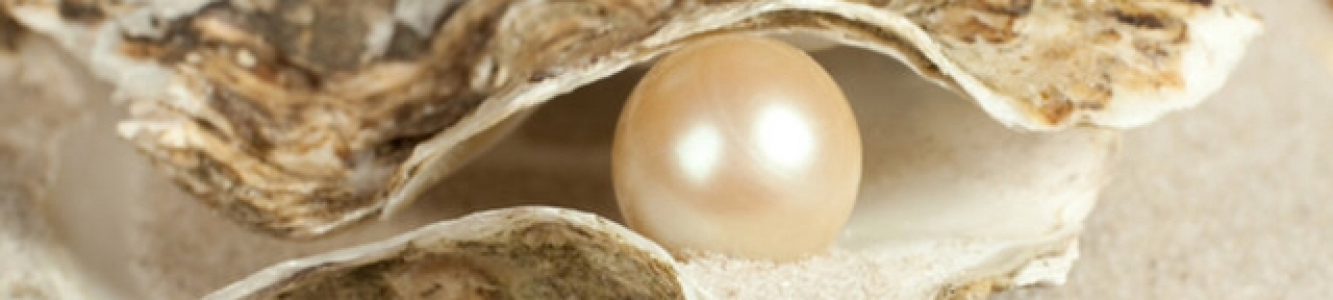
And for another, as I have watched this film time after time, it reminds me to continue my odyssey of seeking silence on my own and with others. I took the DVD with me on my trip around the world in 2019, which inspired me to begin writing this blog (it started as my travel blog), and I watched it with many of the people who hosted me. It provoked some incredible conversations between us. Real pearls.
Silence is something I run towards with a glad heart the more I practise it. I visited my parents recently, and at one point Mum came back having been out, and entered the room where I was simply being silent. She commented with questioning wonder on how silent the whole house was. I think she instinctively recognised that something important and deep, something I would describe as “holy” or “sacred”, even, was going on.
I have come to love the film so much I decided recently to see what Patrick Shen was up to, and found his Patreon. I read a bit of it and instantly knew this would help me stay my course. It seems the making of the film has also inspired a change of direction for him, too. I really admire the different creative approach he is taking as a result. To see, hear and read more click below:
I really hope and pray that these different ways of being we are finding across the world help us to evolve a more gentle way with ourselves, with each other and with our planet. A way that is content with enough, a way that embodies the kindness and quiet joy of silence. A way that deepens our connection with the natural world all around us. This is the way of healing, I think.
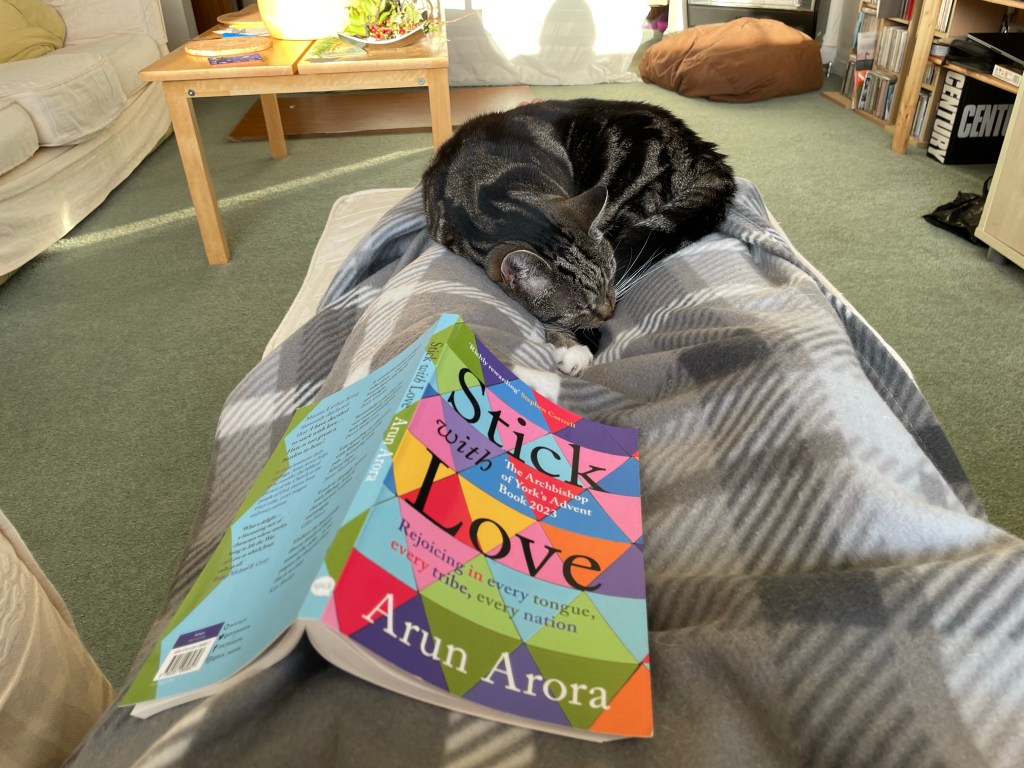
I do like to mark the seasons of the year. This advent (the time of waiting and expectation for the coming of Jesus Christ at Christmas), we have been burning an advent candle to mark the progress of the days. And we’ve been making our winter window that we’ve been doing for the past few years, since someone who lives nearby had the idea to set up an advent windows scheme here. Each day in December another household lights up their window. And I have been reading Stick with Love, which has a short chapter for each day.
In Stick with Love, my friend Arun presents to us a plethora of people from every tongue, tribe and nation, who have somehow managed to enact genuine selfless love in their lives in a way that has brought about profound, positive and lasting change in the world. As he does this, he highlights his and others’ lived experience of racism, and adds his voice to the many who are now helping us to at least begin to set the record straight, and to count black lives as those that matter as much as any.
One of the recurring themes of the book, which I’m just now allowing to sink in, is the way half a story is no story at all. This was particularly highlighted for me by the chapter about George Floyd, whose tragic death in the midst of the Covid-19 pandemic re-ignited the Black Lives Matter movement and brought it to the attention of a mostly neglectful world, finally.
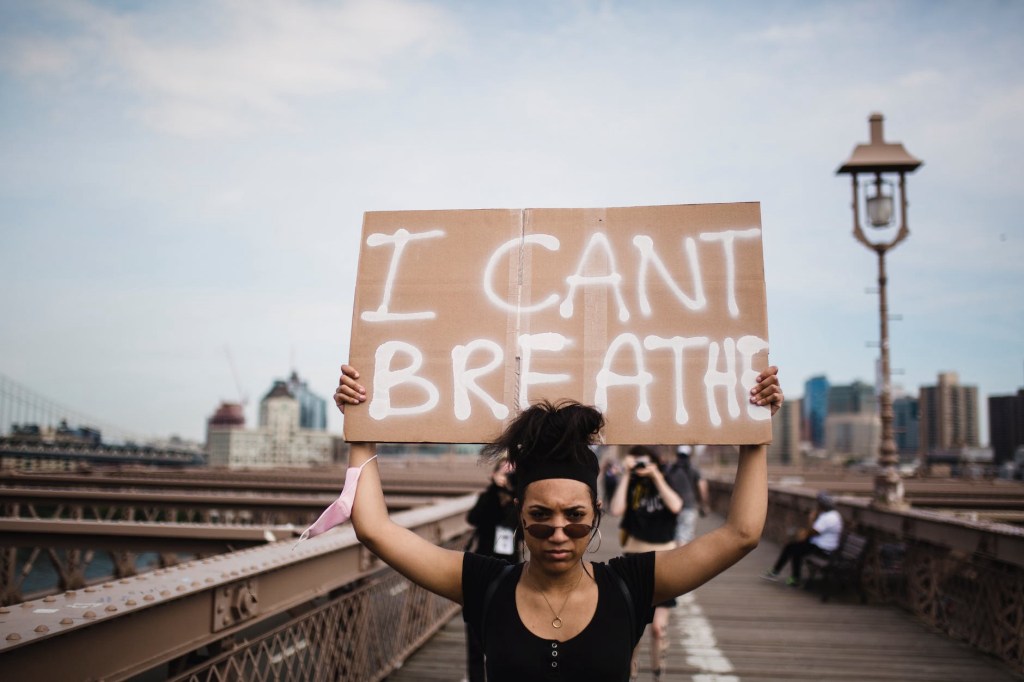
Like many others, I listened to the news reports about what happened to George Floyd, and saw the footage of his neck being kneeled on and heard him gasping « I can’t breathe, man, » and the gist that there was something about him being accused of shop lifting or something. The reports did their job, in that I saw the injustice of the situation and the use of an unreasonable degree of force on him, and I got totally behind the Black Lives Matter protest. But…
I never heard much (any?) background about George Floyd’s life. And that background, sketched out in this book (pages 60-63), sheds a whole new light on the situation. On the depth of systemic racism and also on the goodness and honesty at work in George Floyd himself. It makes me realise again the endless, grinding effect of systemic injustice, and the complexity at work in the lives of those afflicted by it. Arun has written this chapter partly in response to comments posted on social media at the time filled with racist bile, which pile yet more hate onto those who absolutely don’t need. Any. More. Hate.
In response, I am challenged about how often I respond prematurely with hate or rejection in a situation where I barely know half the story? In a stage of life where I don’t suffer fools gladly, « cancel culture » can be a real temptation. But I am reminded that there are real people behind the half formed news stories we hear or read, and in fact everyone I meet is human, too. And I am challenged to find out a bigger story about anyone black, specifically; to educate myself, so I at least begin to understand better where it’s at. Let me do my work and find out a fuller story. And may Black Lives Matter, finally, as they always have done.
I am in a season of exploring a particular kind of silence. It’s a season in a life that appears to be emerging as one longing to be steeped in silence. Perhaps indefinitely.
This short, beautiful film is not silent, but honours the silence that falls at the end of life. The film maker Terence Davies wrote and read this poem, enabling the making of the film (produced by James Dowling and with an award winning score by Florencia Di Concilio), just before he died recently. I think he wrote it in memory of his sister, but it seems a beautiful tribute to him as well.
Passing Time
This is reminding me that, while I follow my odyssey of living silence, true silence will only fall with death. When my friend Jim died suddenly some years ago, I found the reality of his silence – its total finality – one of the hardest things. Jim was a quiet and unassuming man, but also a very gifted bass player. When he died, all the bass lines just disappeared. Our little band never sounded the same again.
A 26 year old woman opened the demo I went on today in Sheffield calling for a ceasefire in Palestine. This young woman was born in Dar al-Shifa hospital in Gaza which was bombed recently. The name of the hospital means “House of healing”. It was built in 1946, before the Nakba in 1948, when the Palestinians were first made to flee their homes by the Israeli government. The hospital predates all of this. It is the biggest hospital in Gaza, whose only purpose is to heal.
As the young woman pointed out, what a shame that our own government in the UK has chosen to say that people would find protests against war “disrespectful” on Remembrance Day. Perhaps members of our cabinet fell asleep in their RE lessons at school? Well, let me enlighten them. This is the purpose of Remembrance Day. Remembrance Day is specifically about remembering the carnage and horror of war and redoubling our efforts to make sure we prevent and stop war in our time, rather than initiating it or allowing it to proliferate. This was Learning Outcome Number One in the lessons every year about Remembrance Day.
When I used to teach RE, the kids got it. They didn’t find it particularly tricky to understand, even though most of their lives had been mercifully free from direct experience of war.
One of the most moving speeches I heard today on the demo was from a young man in his twenties, recounting his experiences of being in Gaza until a few days ago, with his family. Witnessing first hand the carnage, and even having the unbearable experience of seeing some of his own family blown up. I guess some of the young people in our schools now do have direct experience of war. Thanks partly to the inaction of our own government.
There is a growing movement of Jewish people across the world saying, “Not in my name” and crying out for ceasefire in Palestine too. Imagine the fear they faced in coming to a demo like this. But they were there and they were welcomed warmly. Shame on our government, unable to face into its petty fears and speak out to save the thousands of children and innocent civilians dying in this horrendous war.
Jews against genocide
What a great opportunity it would have been, on Remembrance Day of all days, for our government to call for a ceasefire in Palestine. What a brilliant embodiment of all that Remembrance Day was supposed to remind us of. And yet so far not even the leader of the opposition has called for a ceasefire. Shame on us. Shame on us.
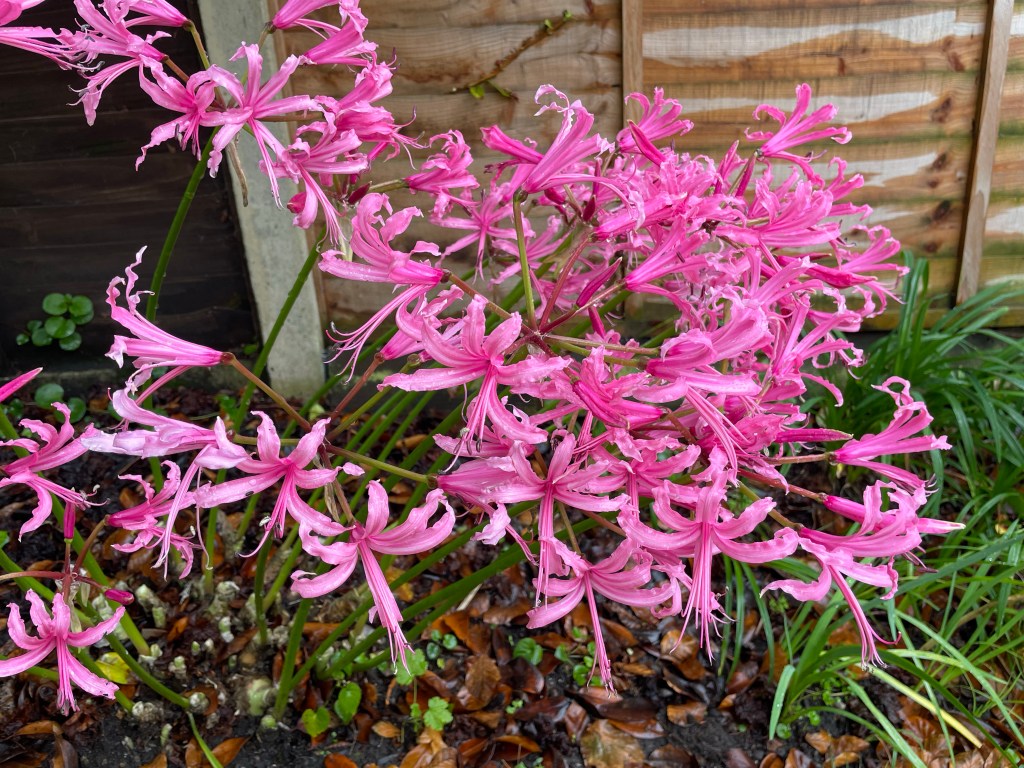
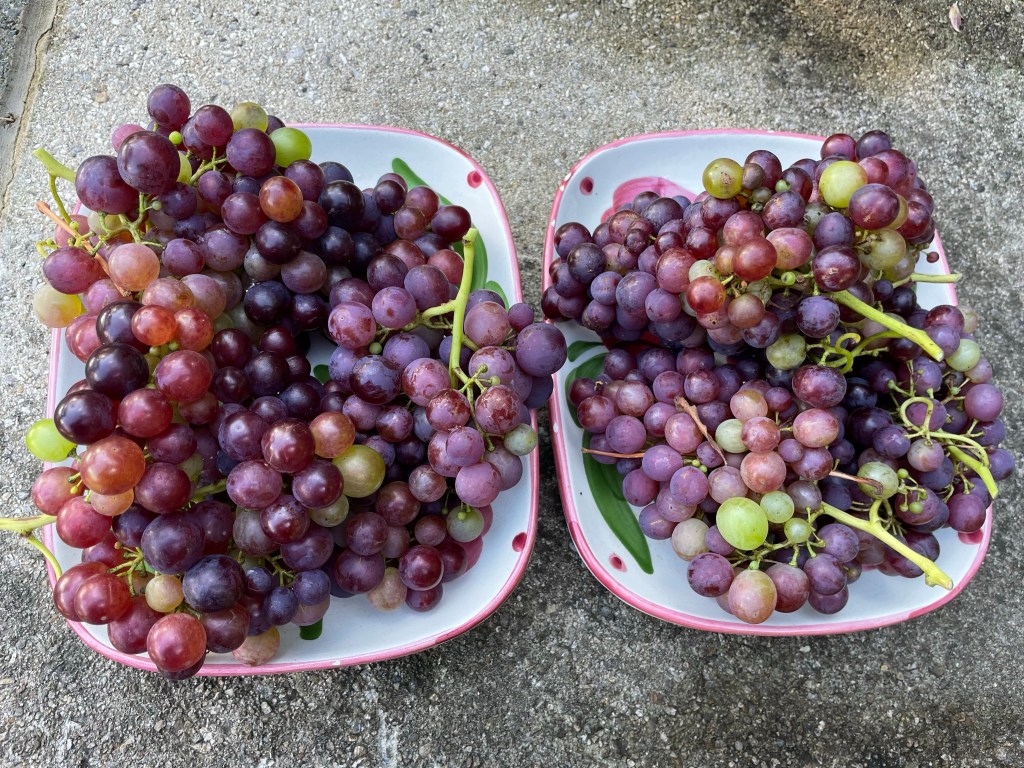
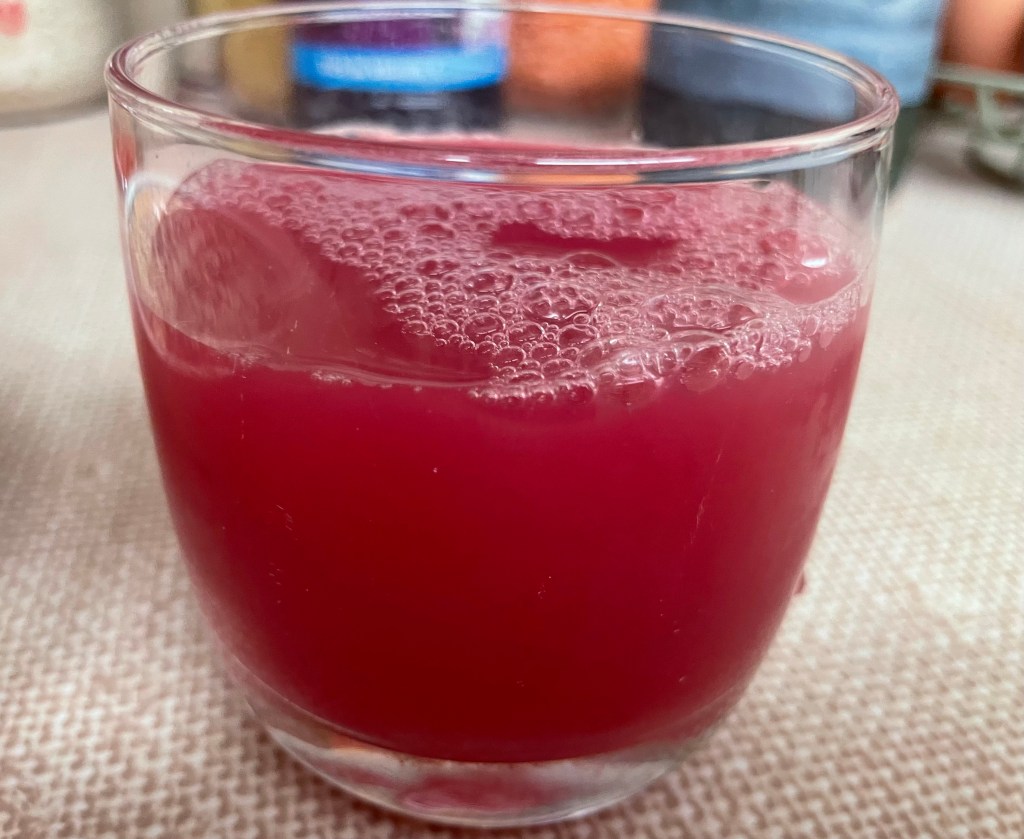
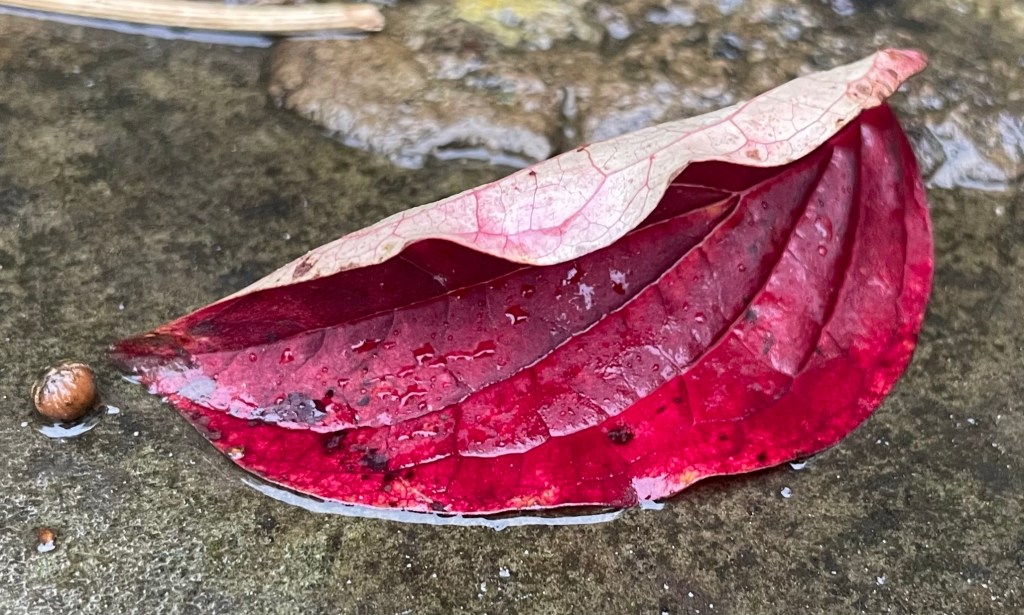
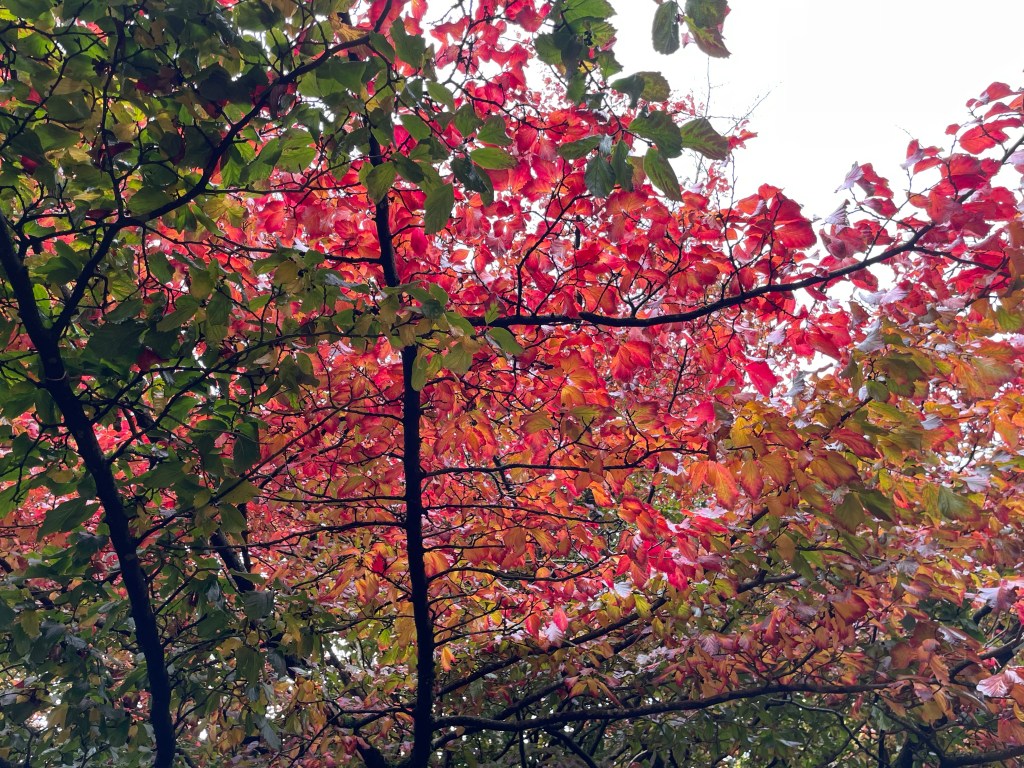
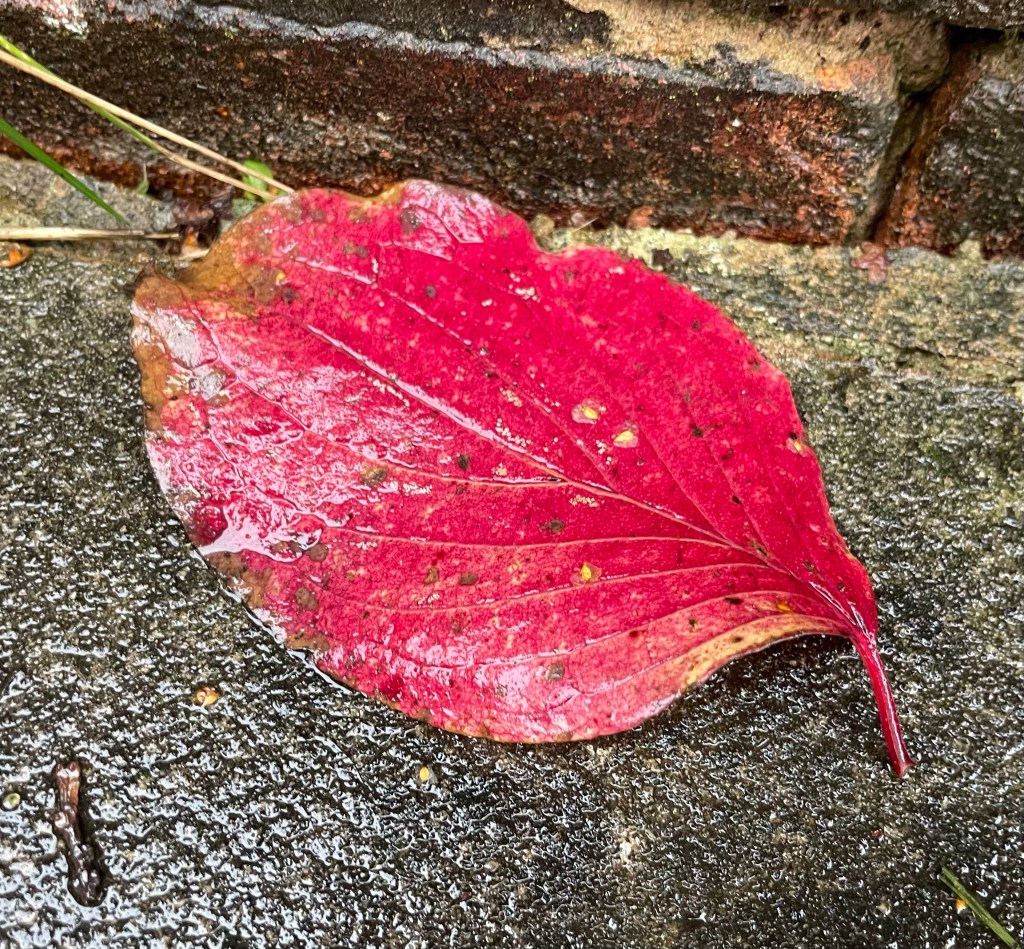
I’m not massively into pink as a colour. But I am noticing with delight some really extraordinary pinks naturally occurring in our garden and other places in this beautiful season of autumn. Sharing some with you…
In the garden of a Quaker Meeting HouseAmazing prolific grapes in our garden in the North of England this yearGrape juice from those grapes! 👆🏼 In a public park
The violence in Israel and Palestine has silenced me. This song was shared with me and is the prayer I most want to join in with. May this prayer be effective. Amen: https://youtu.be/YyFM-pWdqrY
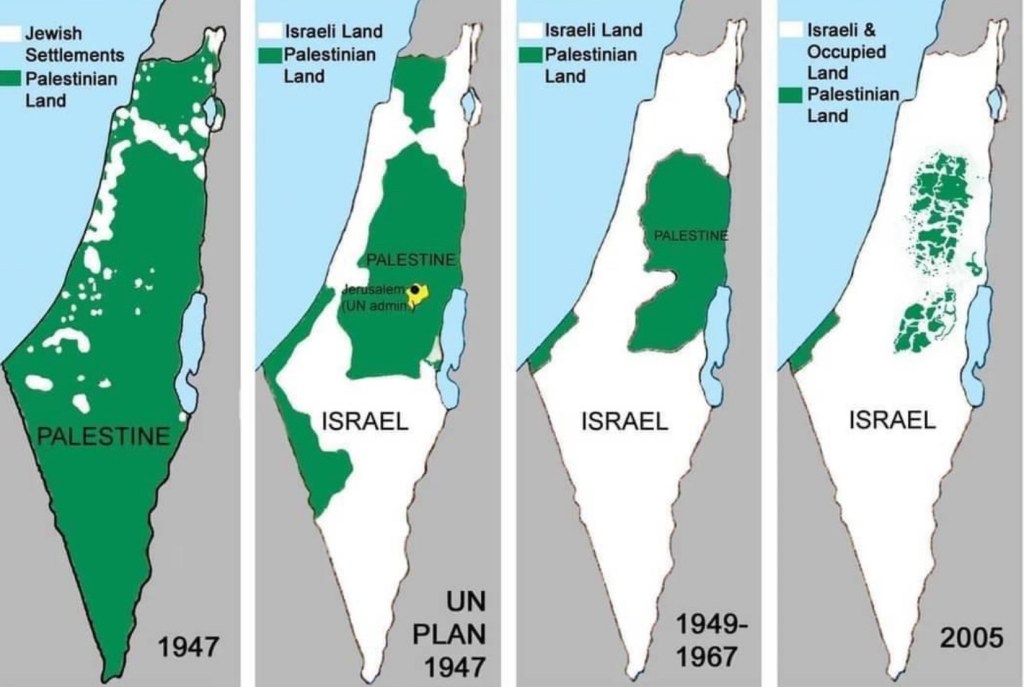
I am speechless to see the reality of the situation in Palestine and Israel in this graphic. Britain was very complicit in this journey, alongside other nations. We were trying to find a home for Jews after the horror of the Second World War when so many of them were killed. I myself have Jewish family background so don’t take this lightly. I have no desire to minimise the terror of anti semitism and the holocaust in particular. But now it’s like the hatred fuelling Hitler’s persecution of Jews and others, which everyone agreed needed to end, has been meted out systematically over the past 76 years against the Palestinians whose land has now been reduced to an unfeasibly small area. This is an over simplification. The Palestinians have not been put into gas chambers or sent to concentration camps. But they have been driven out of their country, or oppressed in an inhumanely controlling regime.
Many Palestinians have fled in order to remake their lives. They’ve had to because they have had their homes and livelihoods (olive farms etc) stolen from them. Looking at the maps above you can see why. Even things like access to water supply, medicine and other basic infrastructure you need to live has been denied to them as Israel has taken more and more land for its own settlements. Most Palestinians in Gaza have had to build water tanks on their roofs in order to be able to survive because they can’t get access to water as they would have done before the Israeli occupation. Imagine having your water supply taken from you in your own country. Imagine that.
There has been a systematic disassembling of the dignity of the Palestinian people for decades. Nothing justifies bombs and missiles, but I can understand the need to find a way to resist, when everything has been taken from you and your family, including many, many lives being taken.
Jews need somewhere to live but I do not believe there was ever any need to take the homes of others to house them. Surely there is enough land for all on this earth? I know it’s more complex, but is it? Really? I know I don’t know, I can’t understand. But the situation is so dire.
I understand the holiness of the holy land, as a Christian and as someone with Jewish heritage. But God is surely big enough to meet us anywhere? And God will work their purpose out without requiring humans to be at war with one another. We are not living in ancient times any longer. And we have the stories in our holy books to learn from. Those of us with faith already know how God can work miraculously, and needs no “help” from us. The constant refrain through the Hebrew Bible is to look after the foreigner in your midst. Look after them. Not strip their dignity. God desires mercy, humility and love for those disempowered, not sacrifice and not violence, surely. If this were not the case, why would we worship God?
We look after exiles and refugees, remembering we were once exiles ourselves in Egypt. That’s the refrain in the Hebrew Bible (Old Testament). We all have ancestors who were exiles or refugees if you trace our ancestors far enough back. And in the future we may all become refugees again due to war, unpredictable flooding or drought, other extreme weather events or political events beyond our control. I think this should affect the way we treat others who are refugees or exiled from their homelands today, and how we treat others still attempting to live in their homeland under occupation, too. We are all ultimately brothers and sisters anyway.
I don’t know what the answers are, but I have a weariness with war and violence. This is a heaviness of heart, which surely must be shared by people on all sides of the conflict by now?
I remember teaching about this conflict decades ago. The teenagers I taught then used to say to me, “Miss, why do adults fight?” We looked into it all; the history of the land, its significance to each party. When squabbling broke out in the classroom, I drew their attention to it and said, “Look – here you are criticising adults for fighting, and you’re fighting yourselves…” But at the end of the day, I recognised their question as valid.
At the end of the day I am a long way from Israel and Palestine. I don’t know how people live in the midst of the constant threat of bombs and violence. How they manage to survive when it takes them three hours just to get through a checkpoint in order to get to work in the morning not far from where they live. (I don’t know how you find patience for that sort of thing, when soldiers presumably following orders from somewhere deliberately take hours over something that could take minutes? When the whole idea that you can’t just pass by easily is meaningless anyway, since this was once all just the country you lived in, with no impassable walls and borders through the middle of it.)
I don’t know how it feels to lose a daughter or a son who really believed in working for peace at the hands of others who didn’t even know them but who have developed such a strong sense of hate that they are ready to take human lives seemingly indiscriminately.
I am not condoning violence on either side, but I am trying to understand where it is coming from. And I am longing and praying for alternative ways to be found now. For those who want to walk humbly and embody kindness and mercy and creativity to come to the fore and be watched, listened to, attended to and followed.
For anyone wanting to understand more from the Palestinian angle, I recommend this humane, poignant and revealing book by Raja Shehadeh: Where the Line is Drawn: Crossing Boundaries in Occupied Palestinehttps://g.co/kgs/B48QYx
When I think back to my teaching days, I wonder whether young people may bring a wholly different approach to these age old conflicts? Here come the young. May they bring hope, vision, compassion, creativity, love and healing in their wake. Martyn Joseph has voiced this prayer of longing. Amen for the young of Palestine and Israel and all countries: https://youtu.be/BVesEfMD3jA?si=-hb6joC52vLmTRhr
I love spending time with artists and creative people of all sorts. I find their work so inspiring. And mostly it’s there to be lived or experienced, which is an extraordinary gift. Experiencing art of any sort always seems to inspire creativity in me, which is often deeply satisfying in a way I can’t quite explain.
This week I had the delight of seeing Matthew Bourne’s Romeo & Juliet, which sparked a lot of wondering and ideas, as well as reminding me of the striking beauty of light and shadow.
Then I’ve been reading about rest and sabbath as I land finally on a very long-awaited day off today. In this moment of stillness, invited by the slowing of a rest day, my eye caught the pattern of shadows on the wall as the trees were being blown about. I decided to film them, suddenly realising in so doing that in our urban location some massive and possibly awful thing is happening (or maybe many awful things), judging by the number of sirens in the background. I notice these, offer my stillness as some kind of prayer, and return to relishing the moment; the wind, the autumn leaves, the unseasonal warmth which invites my sitting outside.
Watching this back reminds me of Walter Brueggeman’s concept of “sabbath as resistance”. The idea that to be still and rest is a form of protest against the drivenness of our culture.
I receive Patrick Shen’s Patreon as I was so struck by his film In Pursuit of Silence (2015) when I saw it at the Sheffield Doc Fest some years ago. I have since rewatched it and shared it with many others.
I recently looked him up and discovered he is trying to find a different way of making his art that is less driven by the capitalist machinery that I think is threatening to suffocate and stifle creativity in all of us now. So I decided to support him with a tiny but regular gift on Patreon. Already this is proving life giving to me, looking at his short film sketches and following links to the things inspiring his creativity. There is a lot of resonance for me. And an invitation to deepen my contemplative practice myself. And to continue exploring my own creativity.
I notice that all these wonderful life giving things occur to me in moments of rest and recreation. Much though I love my work (and recognise the huge privilege of loving what you do), I am reminded that rest and recreation are what restores me and gives me what I need for life. Without this kind of inspiration, the quality of my work would suffer as much as I would. But even if the quality of my work didn’t suffer, I want the fact that I would and those around me would to be enough to remind me to slow, rest, recreate. (Note to self.)
My lovely Uncle Ken, who was an occasional commenter on here, died suddenly the other week. Ken was a person so full of life, it’s hard to imagine that he is no longer around. His going has left a big gap in a lot of people’s lives.
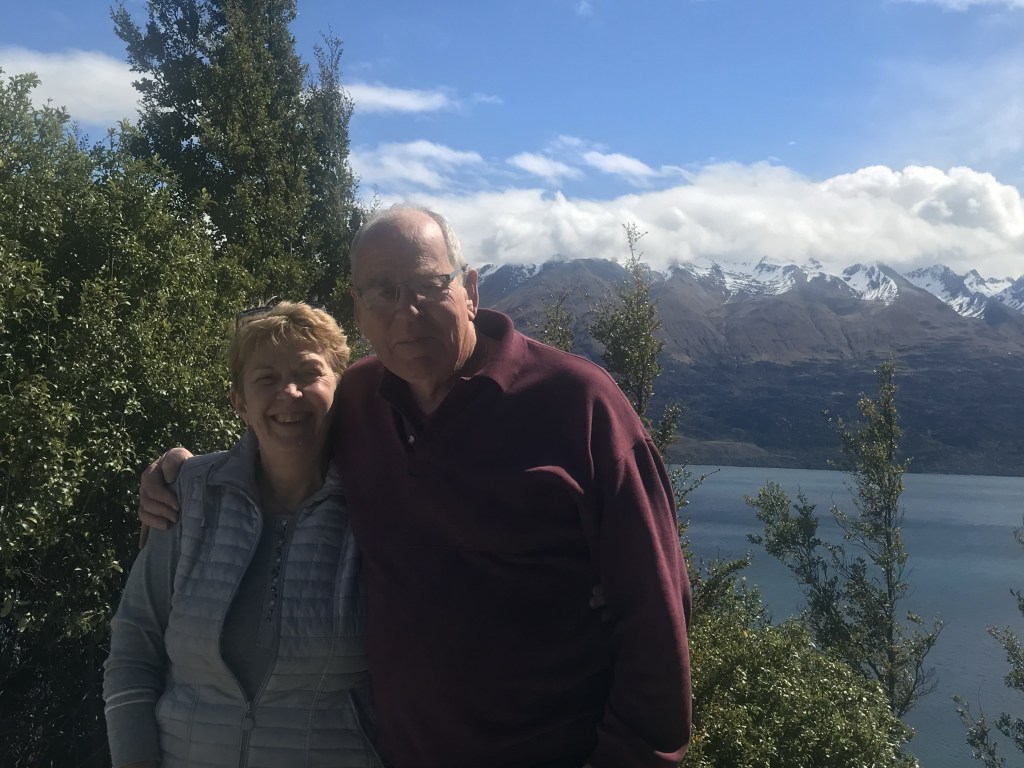
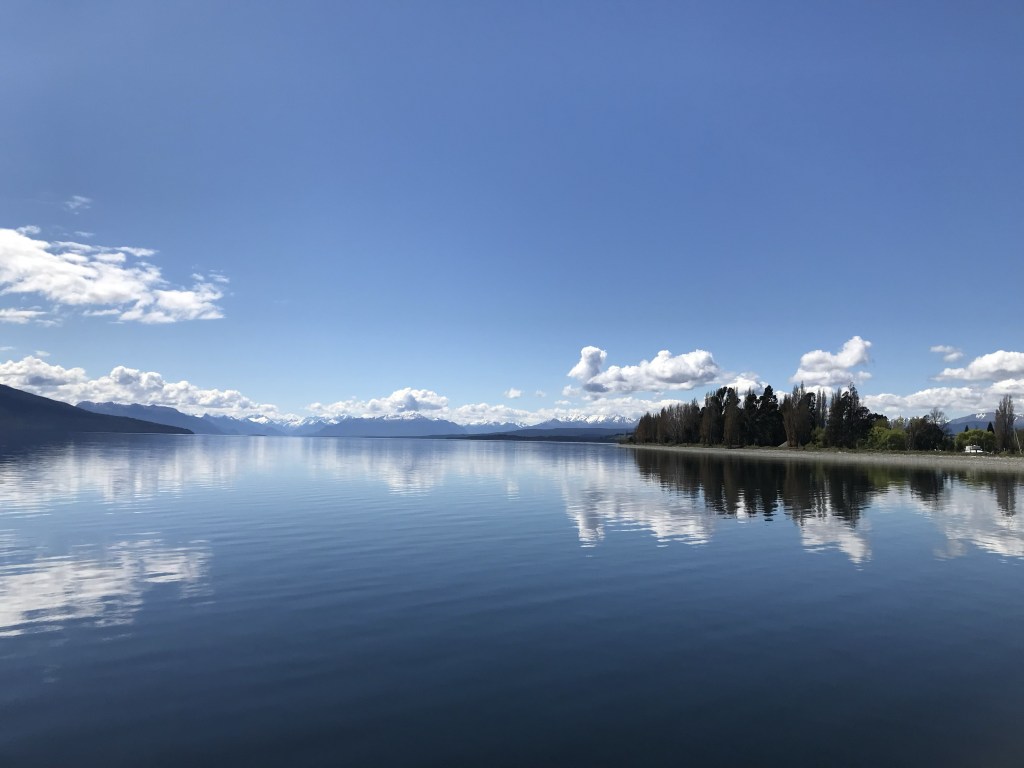
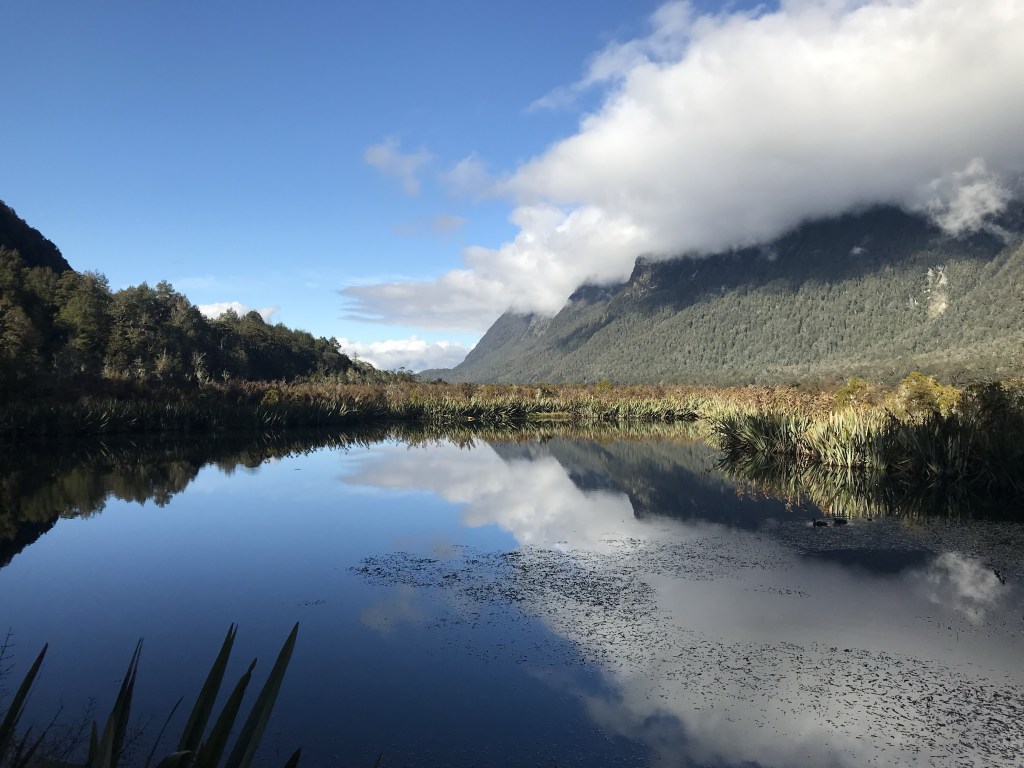
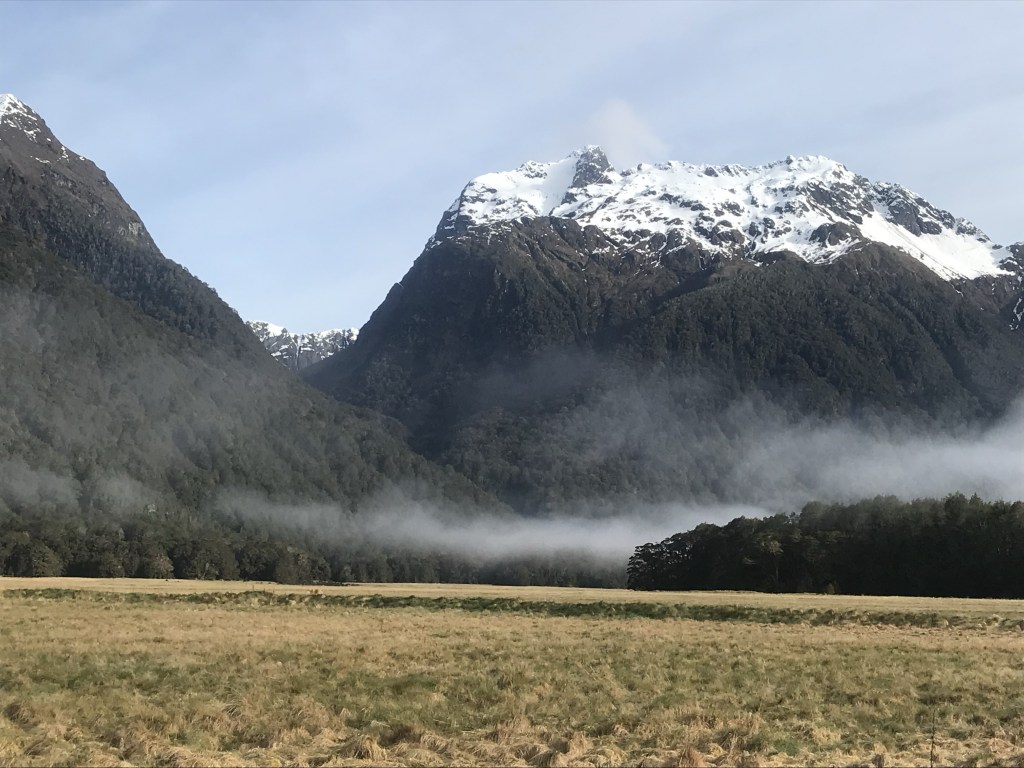
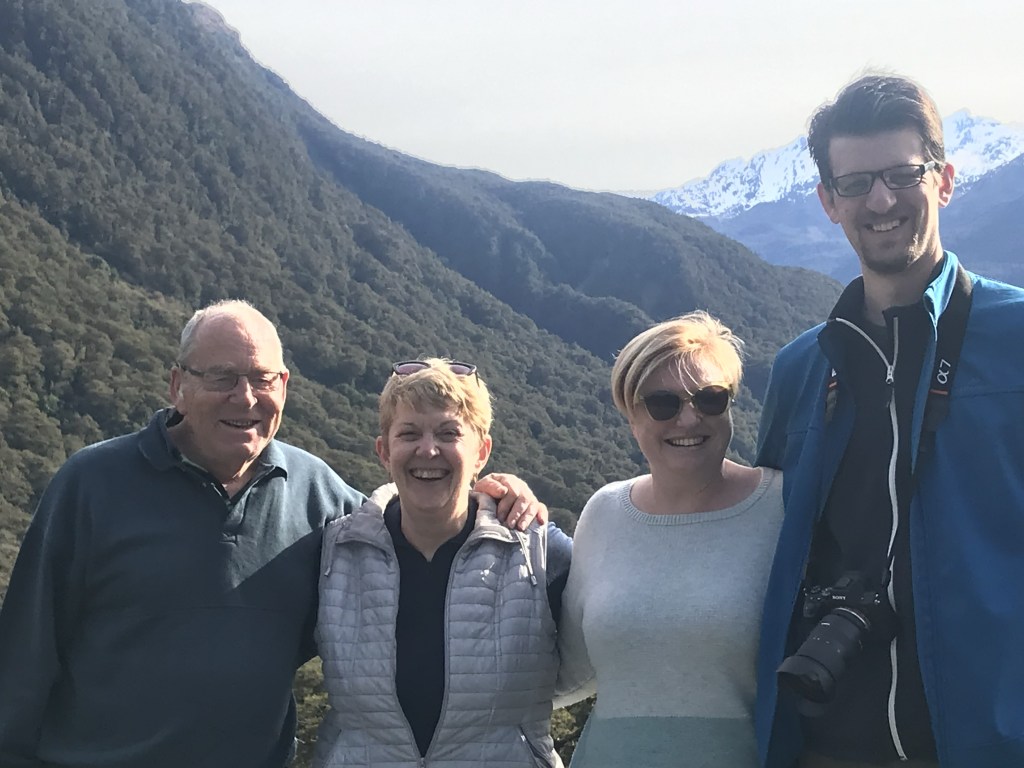
There’s so much I could say about Ken, but one of the things I am most grateful for is that I spent a month in New Zealand with him and Les his wife and Stu and Tash on my world trip in 2019. One of the many highlights of that trip was Ken driving us down the long and so so beautiful Milford Road from Te Anau, past the Mirror Lakes and all that lush green beauty, underneath the snow capped mountains and onto Milford Sound. Les told me Ken had always wanted to drive it himself, having ridden it on coach trips many times before. How wonderful that he got to do this, and I am so grateful to have been there for it.
Ken & LesTe Anau, South Island, NZ. Zoom in to see the snow capped mountains!Mirror Lakes, near Te Anau, South Island, NZBeautiful tui birdsong along the Milford Road (though I didn’t manage to capture the deep resonant notes)Knobs Flat, on the Milford Road, South Island, NZ
Ken was first of all mischievous, and then controversial… he liked a good argument. I remember when I was a teenager and had recently become a Christian, Ken saying to me, “The Bible’s book of fairy tales, isn’t it?” Cheeky, mischievous and argumentative; that was Ken. At the time I wasn’t sure how to respond; I didn’t have the words to say, though my tiny experience of reading of the Bible had felt deep and rich. I think I felt threatened by Ken’s outrageous provocation!
My cousin also encountered Ken’s argumentative mischief a lot. His rather more mature view is that Ken was always pushing people, to make sure we knew what we thought and why. So we wouldn’t be people who lied to themselves, with no integrity, which was something Ken hated. I think Stu is right.
The thing that surprised me about Ken, was when he later said to me, with a twinkle in his eye, “But put in a good word with the man upstairs for us, won’t you?”
I’m not sure how open minded Ken was in general, and maybe he was just hedging his bets, but I have a sneaking suspicion he carried a secret slightly open mind about faith; about God, life, the universe and everything. And I think an open mind is probably one of the greatest spiritual gifts there is. In people of faith like myself, a lack of open mindedness is a sure sign of spiritual disease, as much as it is in people who profess no religious faith at all. Faith is something that opens us to doubt. It allows the possibility that there is more to be discovered, more that perhaps we don’t yet fully grasp. It also makes way for hope, because it introduces a question mark to anything that seems final or terrible or hopeless. Maybe this is not the whole story? Maybe we can only yet see part of it?
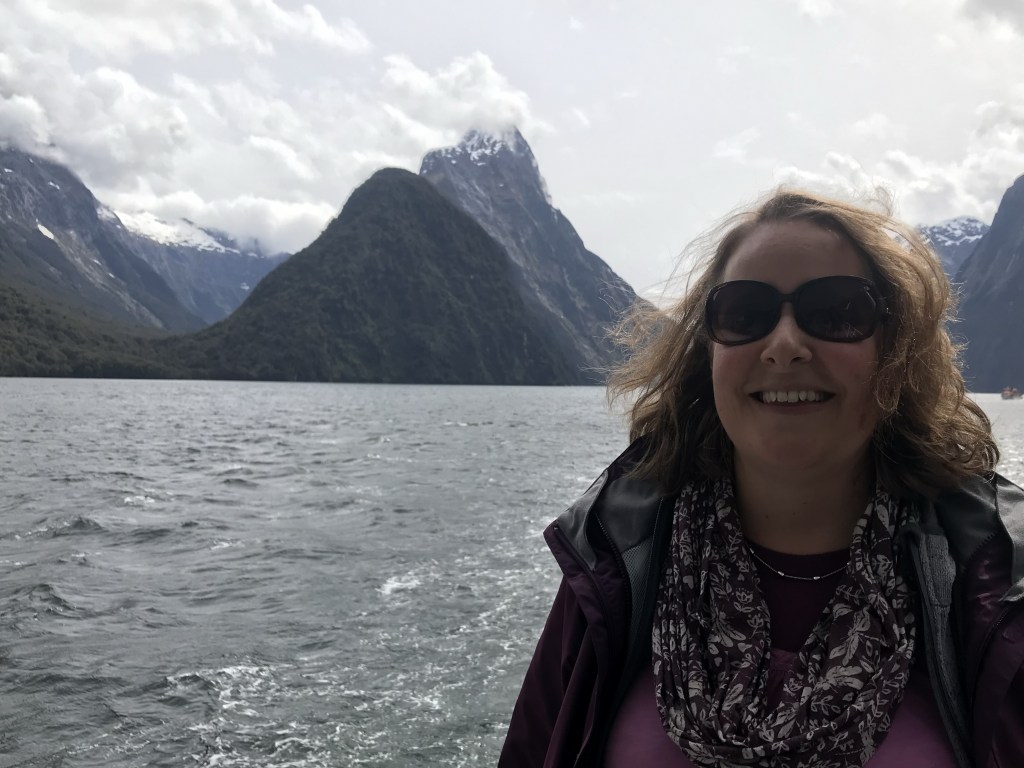
Me at Milford Sound, South Island, NZ
During my visit to New Zealand in 2019, Uncle Ken introduced me to a little book called “The things you can see only when you slow down” by the Buddhist monk Haemin Sunim. One of the wisdom sayings in this book says:
“Love, not righteous words, can change people’s lives.”
Another is this:
“We should love people like the sun loves the earth. The sun loves the earth without choosing to. It nourishes trees and flowers, expecting nothing in return. It does not withhold its rays, but brightens everything with its presence.”
This resonates strongly with how Ken lived and loved I think, and also with how I believe God loves him. And it resonates also with my own Christian tradition, which offers this simple saying: “And now these three remain: faith, hope and love. And the greatest of these is love.” (1 Corinthians 13.13 in the Bible)
O Sun by Peter Mayer
I have entrusted Ken to the love of God. It’s my way of putting in a good word for him. Not that he needs it at all. I believe that Ken was the apple of God’s eye. And our love for him is a faint reflection of God’s love for him and for all of us.
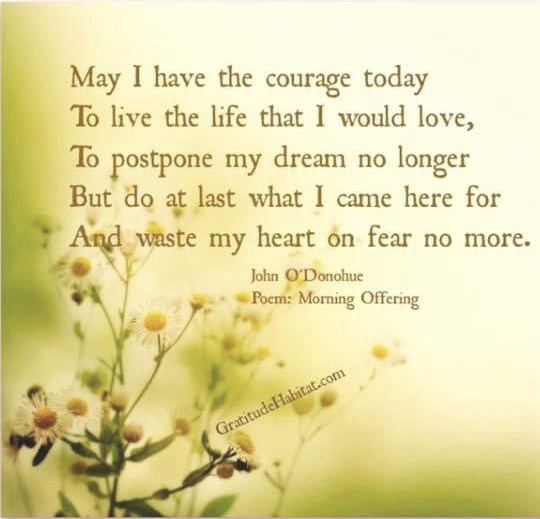
And because Ken was so full of life, when a reminder of a previous post popped up on my socials the day after he died, I received the gift of these words by John O’Donohue again:
And I realised perhaps my best tribute would be to live life to the full, as Ken did.
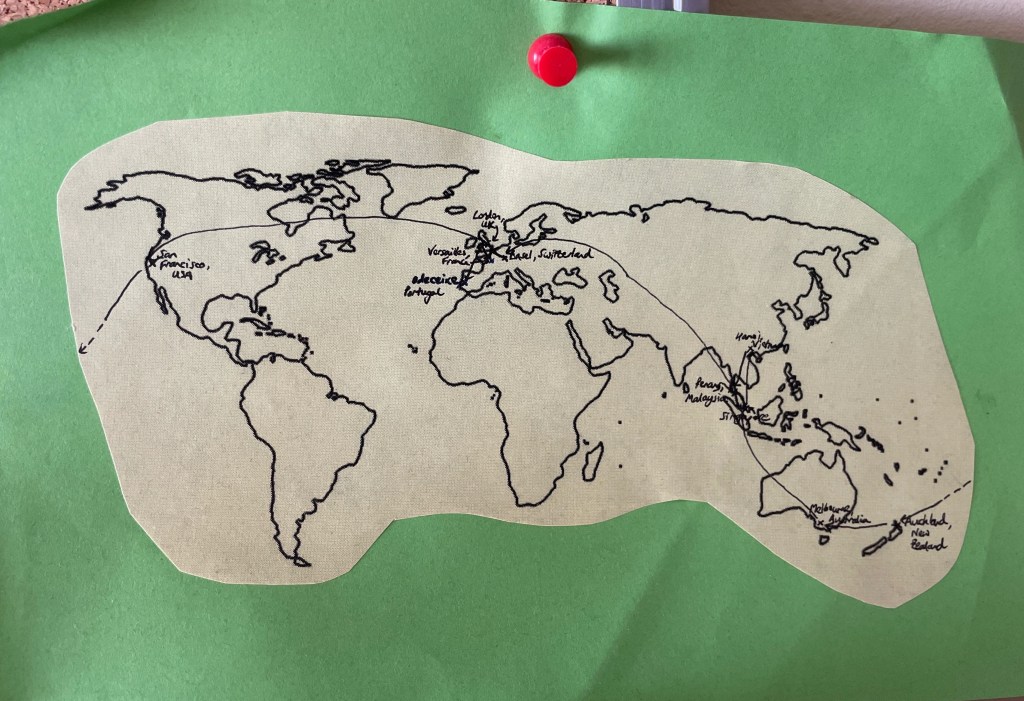
4 years ago, just pre-pandemic (September 2019), I set off on my travels around the world. Wow. Wasn’t that a thing? France, Portugal, USA, New Zealand, Australia, Singapore, Vietnam, Malaysia, Switzerland. Such a gift.
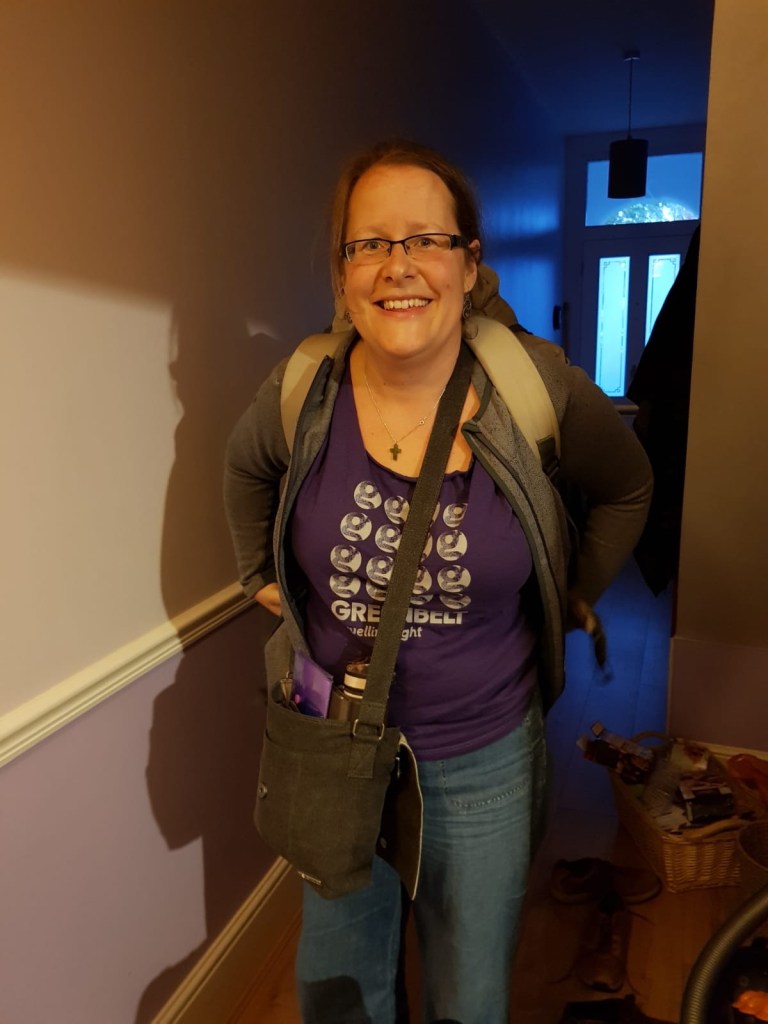
In my cousin’s hallway ready for the off…
I began this as a travel blog to share my pictures and reflections as I travelled.
My anti clockwise route to evade jet lag
Everywhere I went, I spoke with people about silence, connection with nature, and with women to encourage them to come into their own, and with everyone about climate crisis. And I listened to some extraordinary pearls revealed along the way. People are so resilient and by and large very good. Such shared humanity on a trip of a lifetime. I am grateful 🙏💕🌍





 la perle