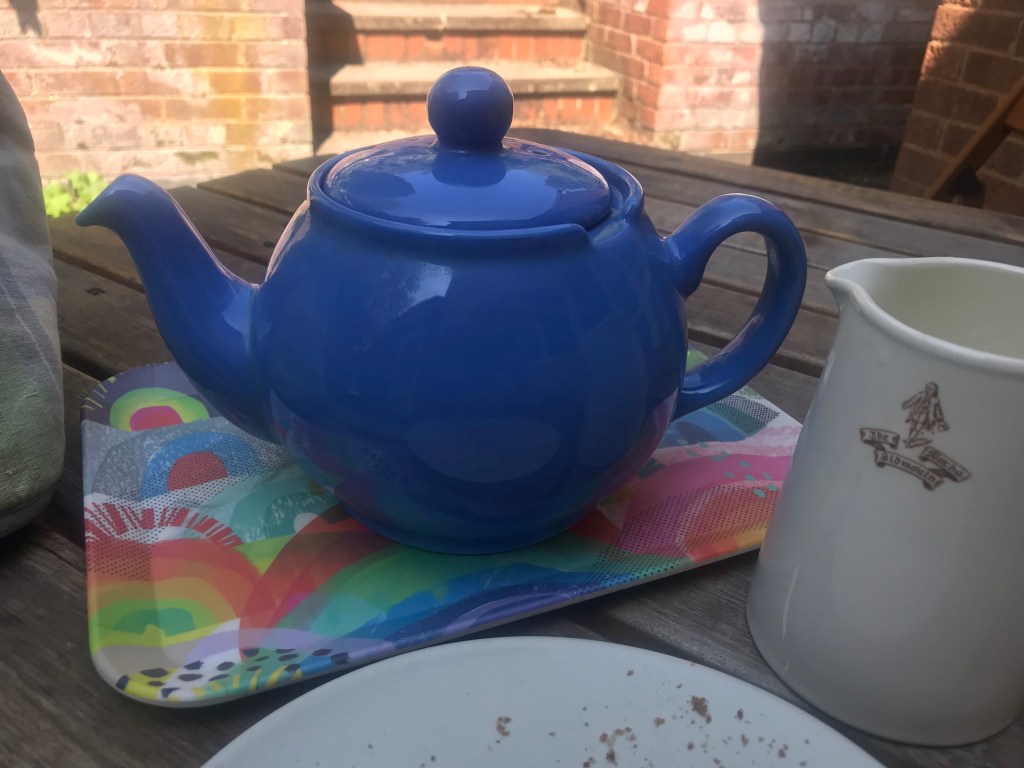
Home, to me is a pot of tea. It’s amazing what is contained within that pot.
The quiet, fizzing thunder as it’s filled; The cosy slips noiselessly on and we wait. We wait for the magic to stir… for in the belly of that pot brews Welcome, Peace, Rest. The pot invites a slowing down, toward complete stillness… Here, we know that good things come to those who wait.
Home, to me is a pot of tea. It’s amazing what is contained within that pot.
Then comes the tumbling, bubbling pouring; Wisps or billows of steam issuing from the mug, depending on the weather. For everything about a cup of tea is adaptable to circumstance; It can warm chilly hands and heart or refresh you on a hot summer’s day or knit together nerves which are in tatters.
Home, to me is a pot of tea. It’s amazing what is contained within that pot.
In any other context the murky colour of black tea with milk would seem unpromising. But in the context of tea it promises much. A pot of tea is An Opportunity. A moment for daydreaming a kaleidoscope of wonders, for brewing a great project, or for sifting through the fiasco that just happened, or for unearthing pure gold from half forgotten landscapes. And the wonderful thing about a pot of tea is that all this can be done alone or with others.
Home, to me is a pot of tea. It’s amazing what is contained within that pot.
Once the pot is on the table before you, you aren’t going anywhere. And yet, there’s no stopping you.
The thing that strikes me about this short text this morning (it’s from Ephesians 5.8 in the Bible), is the confidence of it, and that it’s stated as fact; “You once were darkness but now you are light”. I’m also struck by how it’s talking about modes of being. It doesn’t say, “You once walked in darkness”, or “You once were like darkness”, or “You once were blinded by darkness”. It says “You once were darkness”. That’s a pretty powerful statement. And equally powerful is the strong assertion “but now you are light”.
For the last few weeks I’ve been using this 8 minute « examen » meditation at night time to ground me: https://youtu.be/cAFbD5jCGNI
One of the things I have loved about it, is the invitation to « Come home to yourself, » and to « lovingly accept into your home the person you are… » It is so resonant with the Derek Walcott poem in my previous post on here.
I think being able to set your feet on the ground, to still yourself, and to lovingly welcome yourself into your own home is such a gift. And it is very elusive, particularly for the millions of people who carry anxiety in their bodies daily. That’s why I have found this short meditation to be a good one to practise daily. I am hoping that over time, by practising it, I will settle into this calm and spacious place more quickly. Already, after a few weeks, it’s making a difference to me.
By « coming home to yourself », I mean coming home to who you are, wherever you are; whether you are currently living in a tent, on the street or staying with family or friends or house-sitting or living in your own home. The ability to come home to yourself doesn’t require you to own your own property or even to be living in a fixed place (although if you are constantly moving from one place to another it may be more difficult to do…More difficult, but perhaps more necessary?).
The main challenge of the examen is to review and re-member a moment of delight and love in the day past, and a moment of regret or discomfort. I have a tendency to remember the moments of delight more than the moments of discomfort. Maybe that’s a survival thing? But I love that the meditation invites me to not only remember the positive and the negative, but also to entrust them both to the silence within me. Then it invites me to be still and to let divine love enfold both my moment of delight and my moment of discomfort. I love that. It’s a challenge, but I love it. And I think it’s deepening my sleep…
I’m not sure why… maybe it’s the increase in activity with the easing of lockdown restrictions, and the surging back of stuff in the diary? But I have felt like I have been greeting myself passing lately. Apart from moments of delight on occasional walks, or in times of meditative stillness with others or on my own. Then, I arrive, I am 100% present in the moment.
This poem is helping me to come home to myself in a wonderful way. Short but profound:
Imagine if every tweet, every social media post, text message, email, came to you in the form of someone speaking directly into your ear. Even as you scroll through a newsfeed or your emails, everything you half look at, spoken out loud into your ear. It might sound something like this:
This YouTube recording comes with a warning and an invitation. The warning is that it’s a recording of ten whole hours of people talking. The fact the creators felt the need to warn us should tell us something about the impact of listening (or even half listening) to that much conversation! The invitation is for people to listen to it all the way through and post in the comments when they’re done. Judging by the 2.6K comments, some must have managed it.
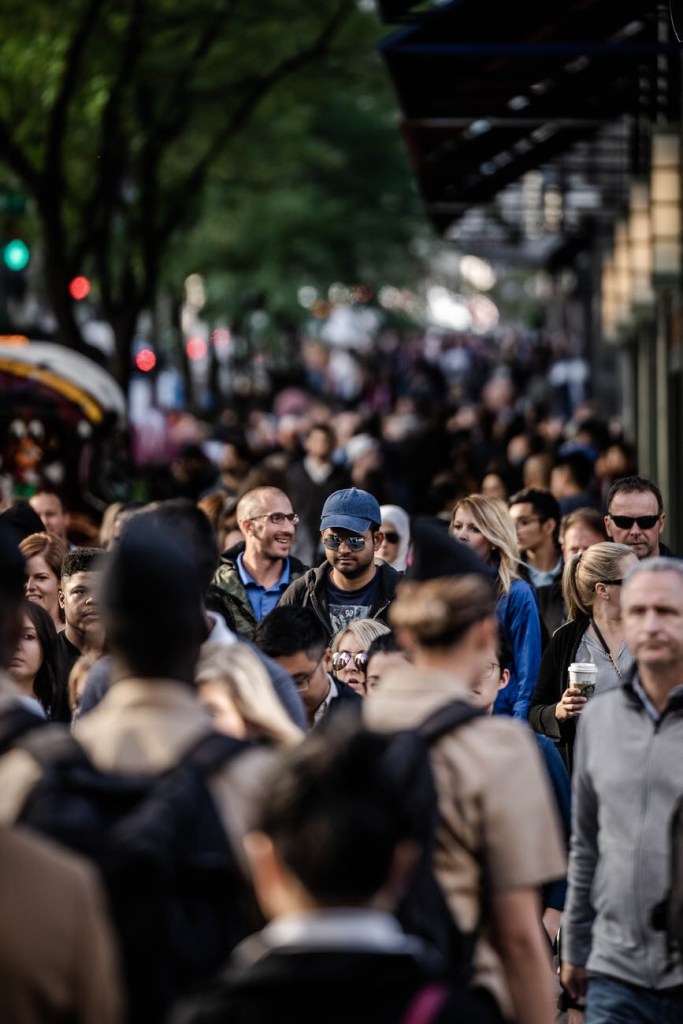
I think the amount of communication we are exposed to in an average day is really quite like listening to this. No wonder I sometimes (who am I kidding – often) feel overwhelmed with the sheer volume of talking. Even though in the past year of global pandemic I guess a lot of people have missed the babble of being in a crowd. (One comment on the YouTube recording poignantly asks, “Who’s here during quarantine trying to remember what people are?”)
Yesterday we had one of our monthly Quiet Days. It’s the first time we have been able to invite people to come round since the pandemic hit last year. The Great British weather was predictably throwing it down by mid morning, so it was great to be able to be inside the house, albeit with the windows wide open for ventilation to reduce the risk of Covid-contagion.
It’s no wonder I increasingly find these set aside times for being quiet so essential. I normally turn off my phone or put it on aeroplane mode for the day. At a couple of points during the day for quite a while the building work next door stopped. Listening to the birds and the rain was glorious. And going outside and being in it, doing some careful weeding to give some impossibly blue flowers space to breathe, touching the earth and smelling the wet grass was so good.
Freeing up my attention to notice and enjoy all these things was such a necessary thing. As is often the case, turning my attention completely away from my phone, and any form of communication other than with myself, with the earth, with other living creatures, with the divine, was a joy.
Yesterday I also enjoyed doing this in a shared physical space. We have had Quiet Days in the past year where we connect with people for short video calls a few times through the day which were OK. But there is a particular gift we offer one another by physically being in each other’s presence but not speaking to each other or expecting anyone to speak or to listen to us. It’s a rare social environment where we agree to offer one another the gift of silence. We are considerate of one another in how we inhabit the space, but the consideration is silent.
We broke the silence for lunch together which was also a delight. And at the end of our time people could share whatever had come to them in the silence if they wanted to. There were just three of us this time. A lot of people say they want to make time for this sort of day, but it seems really difficult practically for people to do it, for a whole host of good reasons.
But I am thinking this sort of time (maybe not a whole day for everyone) is only going to become more necessary, given the extreme demands on our attention…?
A friend recently shared the poem « The wrong beds » by Roger McGough. It’s a brilliantly observed piece reflecting on life as a hospital ward. It ends with the line « We didn’t make our beds. But we lie in them. » There is such a lot to ponder in that…
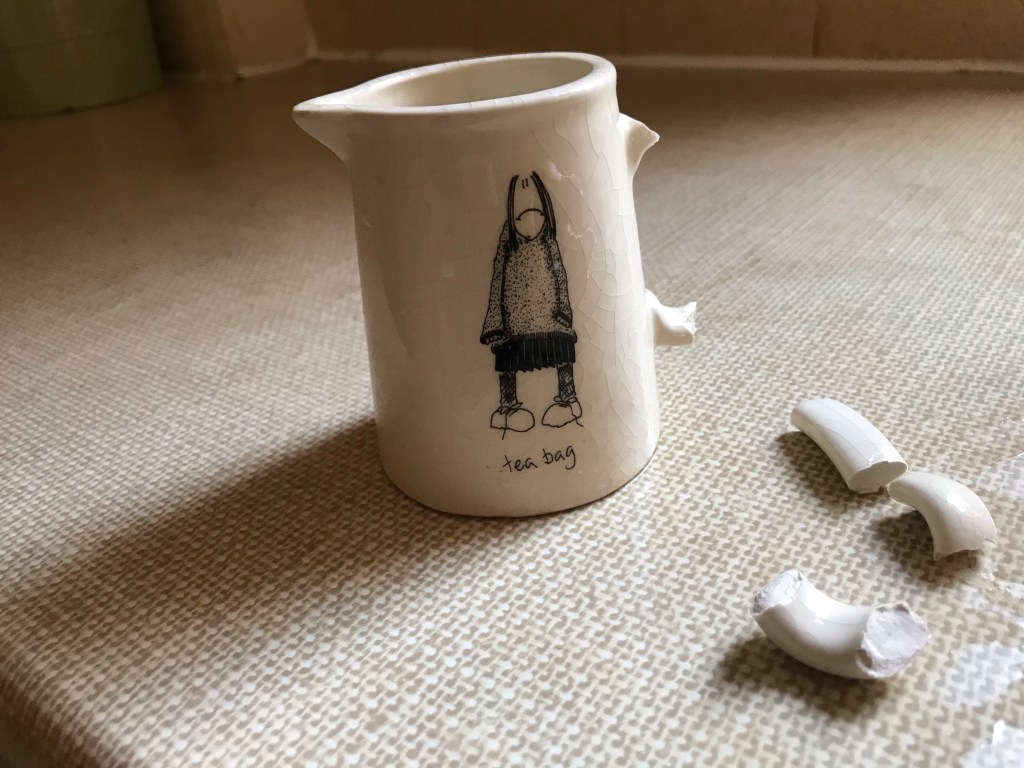
A day or two after my friend had shared the poem, I accidentally knocked my favourite little milk jug on the floor, and the handle shattered. I bought this funny little jug on holiday, and although it has always annoyed me that it won’t go in the dishwasher, it holds sentimental value for me. It reminds me of the friends I was with when I bought it. And it has made a lot of people smile since.
The timing of discovering the poem and breaking the jug made me wonder about blame. We often assign blame saying, « You’ve made your bed. Now you’ll just have to lie in it. » or « I suppose I’ve made my bed and now I’ve got to lie in it. » I immediately berated myself for being so clumsy and knocking over my jug. But I was so tired when I did it, it’s not a surprise. And was it my fault that I was tired? Maybe partly. Maybe not wholly…?
What I love about McGough’s poem is the thought that maybe we didn’t actually make our own beds. And if we had had the opportunity to make them, we wouldn’t have made them here, or like this. They are in the wrong place, always, it seems, no matter where they are.
When we’re in hospital we don’t make our own beds, but we know we should be so grateful for those who make them for us. (And even saying this here makes me remember how grateful I must be that in the UK we have hospitals and people whose job it is to make the beds in them. Not something all of the world’s population experiences, which fact the pandemic has brought more to our attention lately.)
So when we lie in a bed that we didn’t make for ourselves, but which we somehow ended up in anyway, what will be our response? When through no fault of our own, we find ourselves ill, living with a health condition we never asked for? Or we are misunderstood, disbelieved, or something is missed and as a consequence, we suffer? What then will be our response? We sometimes have to lie in the bed that is made for us, whether we like it or not.
And that goes against the grain in a capitalist society where we are constantly bombarded with adverts telling us we can have whatever we want. This is a lie, in fact. And even those with vast stores of wealth often do not have what they want. In fact, I wonder whether many of us even know what it is that we want or need most deeply.
Perhaps people who have less material wealth will teach us something about what is most needed? Certainly they would know more about that than the makers of adverts, or the publishers of glossy magazines, I think…?
« We didn’t make our beds, but we lie in them. » When there’s a fight to be fought in the name of justice and peace about the beds we find ourselves in, may we find others to join us for the fight and give us courage to speak out. And when the beds we lie in are actually a real gift, may we appreciate them as such, and may those whose hands have made them for us be blessed.
I am a musician and have always loved music. It has come to me as a gift, always. Recently, I had the rare opportunity to enjoy quietly sitting with a couple of friends and listening to some of my favourite music together. This is something I have only done a few times in my life, but every time, I have found it so moving that a friend has been happy to let me share some of the music I love with them. And that they’ve found the patience to keep listening to the end.
The last time I ever saw him, a good friend who was dying of cancer some years ago asked me what I’d like to do. We went for a posh coffee and some quality time, then I drove him home, and while we waited for his wife to return, he suggested we listen to some classical music together. He said he knew nothing about this kind of music but he enjoyed it, partly because he knew I loved it. As we listened, we fell silent, and this last time I spent with him was such a gift to me.
Here is a short but, I think, exquisite little piece from Walton’s film music for Henry V; a film of the Shakespeare play. The scenery in the video is beautiful but not particularly linked to the music, although I suspect it is of English countryside, and this music is very definitely English. The title is the cue “Touch her soft lips and part”:
« Attention is the rarest and purest form of generosity »
Simone Weil (published in the posthumous collection of her writings, Gravity & Grace, 1952)
I love that thought. Being truly generous is important, I think. It’s such a joy-bringing thing. And I think I recognise from experience how precious the gift of attention can be. Attention to another human being; total, kind, open and generous attention. And also attention of the same sort towards other creatures and the whole natural world.
Having a rescued cat has drawn my attention more deeply towards other creatures (including plants, trees, rivers and stones). Or perhaps has reignited the way I used to attend to the natural world when I was a child? And, along with the poetry of Mary Oliver, has deepened my attention to everything. And this whole process has deepened my gratitude for the wonder of it all; for the natural world and for my fellow human beings.
All of which, in a time of climate crisis, is so important. Weil continues:
« Attention, taken to its highest degree, is the same thing as prayer. It presupposes faith and love.
« …For there is always light, if only we’re brave enough to see it; if only we’re brave enough to be it. »
Amanda Gorman, at the inauguration of President Biden and Vice President Kamala Harris
River Ouse winter sunset, by Jeremy Timm
This week, I « went » to the webcast of a funeral of a friend, who died far too young, leaving his teenaged daughter and wife behind. It was of course a really sad occasion, but it was also marked by a kind of indefatigable faith, hope and love. His daughter managed to speak so well and she reminded me so much of her Dad, with her courage and her naming of that faith, hope and love as the greatest gift her Dad had given her, and the most important thing now. She was like a blazing light. As Amanda Gorman was like a blazing light reading her poem at the Presidential Inauguration. So today, in the midst of so much anguish across the world, I think it’s not the trite platitude it might seem to be to say there is always light.
I met some other young women the other day, too, at an online community dialogue, facilitated by women. The topic of our dialogue was Covid-19 and the divisions, struggles and positive things that are emerging in our local communities because of it. During the call, one young woman talked about how she’d been made redundant due to Covid, then had applied for a Masters degree, and begun it only to have to immediately relocate back to her parents’ place to study for it online. She talked about her struggles with anxiety and with leaving the house, and how she hadn’t left the house as a result. Then she told us how older relatives and friends of her parents kept blaming her and her contemporaries for causing the spread of Covid, even though she hadn’t left the house. She was justifiably angry. But by the end of the dialogue, she had decided she would post real facts about Covid on her Facebook page, knowing that a lot of her parents’ friends might see it, and they might challenge some of the « fake news » about the pandemic they’d been talking about.
These brilliant young women, like Amanda Gorman, like Greta Thunberg like my friend’s daughter at her Dad’s funeral and like so many of the young women I met on my world trip in 2019, bring me hope. Let’s keep listening to them, keep amplifying their voices and retelling their stories. « There is always light, if only we’re brave enough to see it; if only we’re brave enough to be it. »