

Today, I will be singing in a performance of some extraordinary music by Estonian composer Arvo Pärt. Despite having long been a fan of his music, I had never come across this piece before we began working on it. The words are by St Silouan (1866-1938), who was born in Russia, but in his late twenties became a monk in the Eastern Orthodox Monastery of St Panteleimon at Mount Athos in Greece. Silouan was a mystic whose writings (recorded by others since he was apparently barely literate himself) are profound windows into the depth of his awareness of both the love of God and the depravity of humankind.
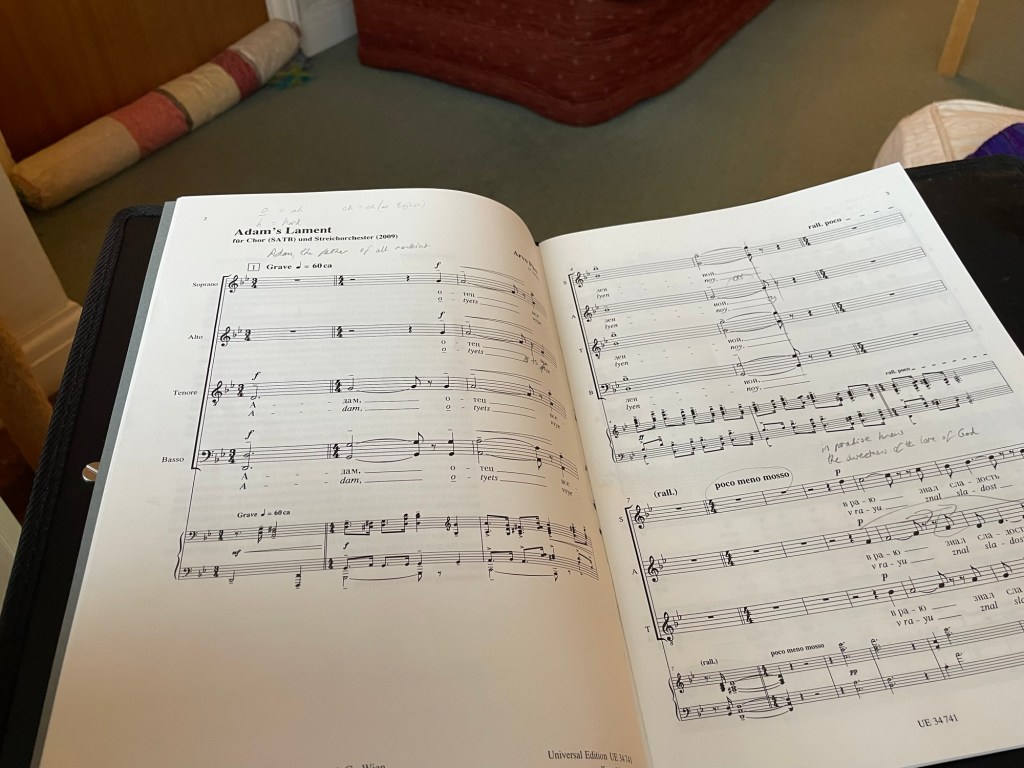
Adam’s Lament is a deep lament for the sin of the first Adam, and the sin of every other human being ever since. Silouan clearly saw his own sin and mourned it as well, along with the sin of all human beings. In these days it is easy to blame public figures for everything that is wrong in the world, but this reminds me that I also have responsibility.
Perhaps sometimes honest tears are the most important work of prayer.
Pärt’s music really just translates these profound words into the language of music for us, in a way that I find speaks more deeply than any words ever could. When I sing it or listen to the music, I find a sense that I know already something of what is being expressed. To me the music is a prayer.
There is no trite resolution in the music, no jubilant ending. But I do find it somehow strangely cathartic to lament in this way through singing it or listening to it. Lament is an ancient prayer practice, that is far more fruitful in my experience than burying our heads in the sand, or wingeing about how things are while still feeling powerless to change them. The profoundly loving nature of God is the ground from which these words and this music were written, which makes the whole thing oddly redemptive, despite the very real grief of it.
In preparation for the performance, I went through and wrote the English translation of the phrases above the music (we are singing it in Russian). It’s quite tricky to work out which phrases belong where, since my Russian is limited to about 3 phrases I learnt from a basic Russian course decades ago! But I noticed immediately how the music itself helped me work out where each phrase belonged. Somehow it had already conveyed a sense of the words to me.
Adam is the first Adam from the biblical story of creation. But Adam is the whole of humankind ever since. Adam is St Silouan, Arvo Pärt, Adam is you, Adam is me. We too have lamenting to do.
Here is the music to listen to (24 minutes). A translation of the words by Rosemary Edmonds is below. NB this level of lamenting may not be for everyone. If anyone is feeling particularly fragile and is not fluent in Russian, it might be better to listen to the music and skip the words below. But that depends on who you are. Sometimes someone else’s words can express exactly what you’ve been feeling and there is hope in the realisation that grief about all that is wrong in the world is shared.
https://open.spotify.com/track/0XgP9WHJbh6yA869jMQXAW?si=C1OARptjQ7CNz3hPQ-xUKQ
Adam’s Lament
Adam, father of all mankind, in paradise knew the sweetness of the love of God; and so when for his sin he was driven forth from the garden of Eden, and was widowed of the love of God, he suffered grievously and lamented with a mighty moan. And the whole desert rang with his lamentations. His soul was racked as he thought: ‘I have grieved my beloved Lord.’
He sorrowed less after paradise and the beauty thereof – he sorrowed that he was bereft of the love of God, which insatiably, at every instant, draws the soul to him.
In the same way, the soul which has known God through the Holy Spirit but has afterwards lost grace experiences the torment that Adam suffered. There is an aching and a deep regret in the soul that has grieved the beloved Lord.
Adam pined on Earth, and wept bitterly, and the earth was not pleasing to him. He was heartsick for God, and this was his cry:
‘My soul wearies for the Lord, and I seek him in tears. How should I not seek him? When I was with him my soul was glad and at rest, and the enemy could not come nigh me. But now the spirit of evil has gained power over me, harassing and oppressing my soul, so that I weary for the Lord even unto death, and my spirit strains to God, and there is nought on earth can make me glad. Nor can my soul take comfort in any thing, but longs once now to see the Lord, that her hunger may be appeased. I cannot forget him for a single moment, and my soul languishes after him, and from the multitude of my afflictions I lift up my voice and cry: ‘Have mercy upon me, O God. Have mercy upon thy fallen creature.’
Thus did Adam lament, and tears streamed down his face onto his beard, onto the ground beneath his feet, and the whole desert heard the sound of his moaning. The beasts and the birds were hushed in grief; while Adam wept because peace and love were lost to all men on account of his sin.
Adam knew great grief when he was banished from paradise, but when he saw his son Abel slain by Cain his brother, Adam’s grief was even heavier. His soul was heavy, and he lamented and thought: ‘Peoples and nations will descend from me and multiply, and suffering will be their lot, and they will live in enmity and seek to slay one another.’ And his sorrow stretched wide as the sea, and only the soul that has come to know the Lord and the magnitude of his love for us can understand.
I, too, have lost grace and call with Adam: ‘Be merciful unto me, O Lord! Bestow on me the spirit of humility and love.’
 la perle
Thank you Ali for this beautiful writing and for the music & translation. Recently I have found myself praying the Agnus Dei not just as an individual, but as a member of Adam, the human race, as we travel on towards the precipice, apparently unable to stop or change course, like St Paul knowing what we should do, but somehow unable to do it.
LikeLike
Thank you Ali for this beautiful writing and for the music & translation. Recently I have found myself praying the Agnus Dei not just as an individual, but as a member of Adam, the human race, as we travel on towards the precipice, apparently unable to stop or change course, like St Paul knowing what we should do, but somehow unable to do it.
LikeLiked by 1 person
Wow. What a profound confluence of prayer 🙏 Thank you so much for sharing this Paul. Heartening to know of your resonating prayer too.
LikeLike
I listened to the piece last night. It must have been amazing to sing.
LikeLiked by 1 person
It really was. Quite a sort of electrifying performance. Manchester Camerata are such an excellent full-hearted ensemble. And the conductor Tom Featherstonhaugh was remarkable. Got the best out of us all. Very moving!
LikeLike